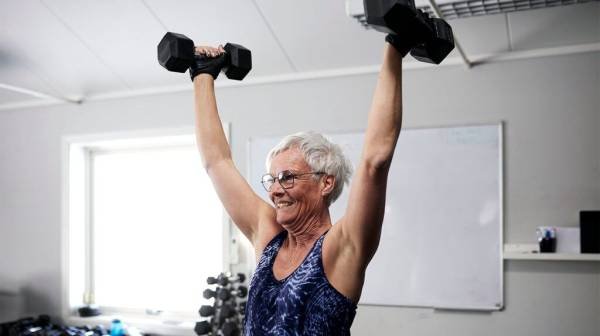
Share on PinterestCould muscle strength serve as a key longevity indicator for older females? Image credit: Johner Images/Getty Images
- A new study suggests that stronger muscles may be associated with a lower all-cause mortality in older females.
- The association was independent of activity levels, with muscle strength linked to longer life, even among females who did not meet recommended aerobic exercise guidelines.
- In particular, the study found a consistent association between grip strength and lower mortality.
Healthcare professionals often recommend that older adults engage in regular physical activity to promote healthy aging and longevity.
In fact, the Physical Activity Guidelines for Americans advises at least 150 minutes of moderate-intensity aerobic activity and muscle-strengthening activities at least 2 days a week for older adults.
Physical activity can significantly help to prevent or reduce disease, extend health span, and enhance physical function. Exercise influences the drivers of biological aging and can slow aging rates, underscoring its foundational role in geroscience.
As people age, they begin to lose muscle mass and strength, a condition known as sarcopenia. However, a decline in strength with aging can be substantially slowed by exercise. Maintaining strength through exercise may also be instrumental for optimal aging.
A large U.S. study of females ages 63 to 99, published in JAMA Network OPEN, suggests that greater muscle strength is associated with a significantly lower risk of death.
The findings add to growing evidence that muscle strength is a key marker of healthy aging and may play an independent role in longevity.
What the study involved
The analysis included 5,472 ambulatory females enrolled in the Objective Physical Activity and Cardiovascular Health (OPACH) study, an ancillary study of the Women’s Health Initiative.
Participants had a mean age of 78.7 years, and the cohort consisted of 33.8% Black, 16.7% Hispanic, and 49.5% white individuals.
Between 2012 and 2014, the participants completed an in-home physical performance test and wore an accelerometer for 7 consecutive days to objectively measure movement and sedentary time. They were followed for an average of 8.3 years. During that time, 1,964 individuals died.
Researchers assessed muscle strength using chair-stand time and grip-strength tests.
For chair stand time, participants were timed while completing 5 consecutive sit-to-stands without using their arms, with faster times indicating greater lower-body strength. Grip strength was measured with a hand dynamometer. Individuals were divided into 4 groups based on strength levels.
Stronger females had lower mortality risk
The researchers found a clear inverse relationship, as higher strength was associated with lower mortality.
After adjusting for age, race and ethnicity, education, body weight, smoking, alcohol use, blood pressure, comorbidities, and other health factors, the researchers found that females in the highest grip strength group had a 33% lower risk of death compared with those in the lowest group.
Additionally, those with the fastest chair stand times had a 37% lower risk of death.
Importantly, muscle strength was associated with lower mortality, even among individuals who did not meet the recommended 150 minutes per week of aerobic activity.
Kristen Lettenberger, PT, DPT, CSCS, physical therapist at Bespoke Treatments, was not surprised at the association between muscle strength and longevity:
“Strength training is a great way to improve heart health, preserve bone density and muscle mass, which are all crucial for healthy aging, especially for post-menopausal women.”
— Kristen Lettenberger
“Muscle mass and strength as we age is important for a few reasons. One, muscles are more metabolically active, they help us manage our insulin levels and improve some of our biggest risk factors for cardiovascular disease and type 2 diabetes,” explained Lettenberger.
“Two, being strong improves our balance and mobility, reducing our risk of injury, and helps us maintain our independence. Three, a high muscle mass may also be correlated to reduced inflammation, which can aid in better mortality. Muscle is the greatest gift we can give ourselves,” she added.
Grip strength matters
Although both measures were associated with mortality, grip strength appeared to be a more consistent predictor.
The correlation between grip strength and chair stand performance was relatively small, suggesting the tests capture different aspects of physical function.
After extensive statistical adjustments, grip strength remained robustly associated with lower mortality across nearly all subgroups, including individuals of different ages, racial and ethnic groups, and BMI categories, as well as those with varying levels of physical activity and females who used walking aids.
After accounting for other health indicators, chair stand time showed somewhat weaker associations.
Why might strength matter?
The researchers suggest that stronger muscles might be a sign of better overall health, rather than muscle strength itself being the direct cause of longevity.
Additionally, a notable finding was that strength remained protective even after objectively accounting for total daily movement and sedentary behavior.
The researchers believe that muscle quality, not just muscle mass, may be especially important as people age. Muscle strength may affect the body in different ways, including how it controls metabolism and the immune system, not just inflammation.
Previous research suggests that changes during the aging process may exacerbate muscle loss by promoting chronic low-grade inflammation, as long-term inflammation is known to cause muscle loss and increase the risk of death.
However, taking inflammation into account only slightly weakened the connection between muscle strength and longer life. This indicates that muscle strength may help people live longer for reasons beyond reducing inflammation alone.
Study limitations
While the findings are promising, the study was observational. This means that it cannot prove that increasing muscle strength directly reduces mortality.
Additionally, the study estimated muscle mass rather than directly measuring it, and nutritional status was not comprehensively assessed. Furthermore, the study only included females, so the results may not be generalizable to males.
However, sensitivity analyses excluding early deaths produced similar results. This reduces concerns about reverse causation, suggesting that muscle strength itself likely contributes to longevity, rather than muscle weakness reflecting existing poor health.
What this means for healthy aging
Globally, the number of people 65 years or older is projected to more than double, rising from 761 million in
2021 to 1.6 billion in 2050. Females are likely to comprise a majority of this population. As such, maintaining independence and functional capacity will be central to public health.
This study supports current national guidelines encouraging muscle-strengthening activities at least two days per week. Additionally, it suggests that muscle strength can be easily assessed in clinical settings using simple tests such as grip strength, which may offer a practical screening tool for aging-related risk.
When asked about strategies to include more muscle-strengthening activities, Lettenberger told Medical News Today:
“Bodyweight exercises are great for building endurance and can be a good starting point, and you do not need heavy weights to see benefits.”
“Using weights that challenge you consistently, even just a couple times a week, can make a big difference over time. Ideally, you would mix both strength training and cardio into your routine.”
— Kristen Lettenberger
While more research is still necessary to clarify the most beneficial types and amounts of strength training and whether it can directly extend longevity, this study suggests that building and preserving muscle strength may be just as important as staying aerobically active when it comes to aging well.